C sharp augmented arpeggio on guitar
The C sharp augmented arpeggio (C♯+) has 3 notes: C♯, E♯, Gx (C sharp, E sharp, and G double sharp), degrees 1, 3, ♯5 of the chord. On guitar it fits the 4 shapes of the CAGED system, always root to root: two octaves in the G and E shapes and one octave in the C and D shapes.
- C♯ C sharp 1
- E♯ E sharp 3
- Gx G double sharp ♯5
E♯ is the correct spelling in the chord formula; on the instrument it is the same note as F. Gx is the correct spelling in the chord formula; on the instrument it is the same note as A.
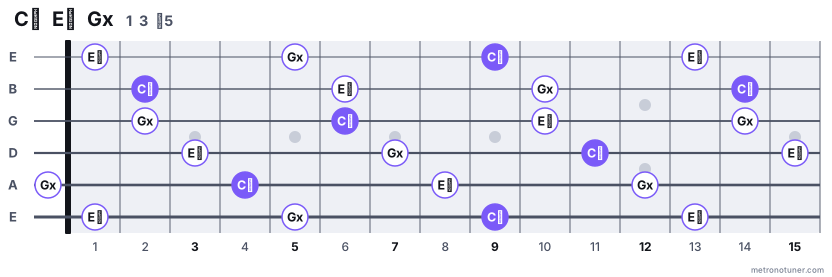
Whole neck: every note of the arpeggio up to fret 15. The root (C♯) is highlighted.
Positions as text
C shape (frets 2 to 4), from the lowest note to the highest:
- string 5: 4 (C♯)
- string 4: 3 (E♯)
- string 3: 2 (Gx)
- string 2: 2 (C♯)
G shape (frets 5 to 9), from the lowest note to the highest:
- string 6: 9 (C♯)
- string 5: 8 (E♯)
- string 4: 7 (Gx)
- string 3: 6 (C♯)
- string 2: 6 (E♯)
- string 1: 5 (Gx), 9 (C♯)
E shape (frets 8 to 12), from the lowest note to the highest:
- string 6: 9 (C♯)
- string 5: 8 (E♯), 12 (Gx)
- string 4: 11 (C♯)
- string 3: 10 (E♯)
- string 2: 10 (Gx)
- string 1: 9 (C♯)
D shape (frets 11 to 15), from the lowest note to the highest:
- string 4: 11 (C♯), 15 (E♯)
- string 3: 14 (Gx)
- string 2: 14 (C♯)
Positions on the neck
The positions follow the CAGED system: the neck splits into 5 regions, each with the shape of an open chord (C, A, G, E and D) moved to C sharp. In each shape the arpeggio goes from root to root: two octaves in the E and G shapes (root on the 6th string), one octave in the C and A shapes (root on the 5th) and in the D shape (root on the 4th).
The augmented chord is made only of major thirds and repeats every 4 frets, so two CAGED shapes give the same pattern: it is shown only once.
The faded notes around a position are chord tones too: use them to extend the arpeggio down or up.
Use Degrees to see the role of each note (1 is the root) and Listen to hear the selected position going up and down, at the tempo you want. With the whole neck, Listen plays the arpeggio from the lowest root.
Diagrams in standard tuning (E A D G B E).
Formula
- C♯
- 4
- E♯
- 4
- Gx
- 4
- C♯
Degrees: 1 · 3 · ♯5 (root, major third, augmented fifth). Distance between the notes: 4 – 4 – 4 semitones, counting the step back to the upper root.
About the augmented chord
The augmented chord raises the fifth and sounds like a "floating", dreamy expectation. It appears as a passing chord between I and IV (C → C+ → F) or in intros of old ballads. It is symmetrical: it repeats every 4 frets, so one shape serves three different chords.
The chord and the scale
- C sharp augmented chord (C♯+) The chord shapes on guitar, with sound
- D flat whole-tone scale The scale to practice with it: it has every note of the arpeggio plus the ones in between.
Other C sharp scales with every note of the arpeggio
More C sharp arpeggios
- Major (C♯)
- Minor (C♯m)
- Seventh (C♯7)
- Major seventh (C♯7M)
- Minor seventh (C♯m7)
- Half-diminished (C♯m7(♭5))
- Diminished seventh (C♯°7)
- Augmented (C♯+)
The augmented arpeggio in other keys
Frequently asked questions
What are the notes of the C sharp augmented arpeggio?
The C sharp augmented arpeggio (C♯+) has the notes C sharp, E sharp, and G double sharp: degrees 1, 3, ♯5 of the chord.
How do you play the C sharp augmented arpeggio on guitar?
With the CAGED shapes, each from root to root: C shape (frets 2 to 4, 1 octave), G shape (frets 5 to 9, 2 octaves), E shape (frets 8 to 12, 2 octaves), and D shape (frets 11 to 15, 1 octave).
Which scale goes with the C sharp augmented arpeggio?
The D flat whole-tone scale, which has every note of the arpeggio. These also have all of them: C sharp Phrygian dominant scale.