E flat diminished (Eb°) chord on cavaquinho
- Notes
- E♭G♭B𝄫
- Formula
- 1♭3♭5
How to play Eb° on cavaquinho
-
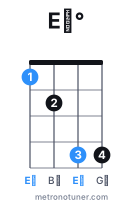
Shape 1 · fret 1
-
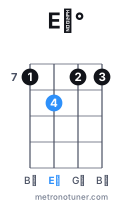
Shape 2 · fret 7
-
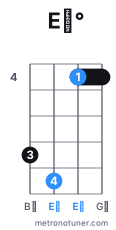
Shape 3 · fret 4 · barre
-
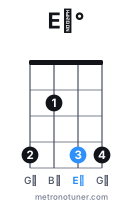
Shape 4 · fret 2
-
Shape 5 · fret 1
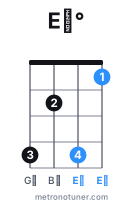
-
Shape 6 · fret 2
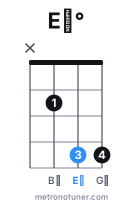
Numbers are fingers: 1 index, 2 middle, 3 ring, 4 pinky. x = do not play the string, o = open string. The coloured dot is the root (E flat).
Eb° inversions on cavaquinho
The same Eb° with another chord note in the bass (the lowest note that sounds). The notes stay the same, but the colour changes, and the bass line can move by step from one chord to the next. In a chord symbol, the bass comes after the slash.
3rd (G♭) in the bass1st inversion · Eb°/Gb
3rd (G♭) in the bass1st inversion · Eb°/Gb
5th (B𝄫) in the bass2nd inversion · Eb°/Bbb
5th (B𝄫) in the bass2nd inversion · Eb°/Bbb
About the diminished chord
Three notes stacked in minor thirds: a suspenseful sound with no place to rest. In popular music it almost always works as a passing chord between two neighbours (C → C♯° → Dm), and in practice it is often swapped for the diminished seventh, which sounds fuller.
Notes and intervals of Eb°
Eb° (E flat diminished) is built from 3 notes. Each one fills a degree of the chord:
- E♭ · 1 · root
- G♭ · ♭3 · minor third
- B𝄫 · ♭5 · diminished fifth
Other E flat chords
- Eb
- Ebm
- Eb7
- Eb7M
- Ebm7
- Ebm7(b5)
- Eb°
- Eb°7
- Eb+
- Ebsus2
- Ebsus4
- Eb7sus4
- Eb5
- Ebadd9
- Eb6
- Ebm6
- Eb9
- Ebm(add9)
- Ebm9
- Eb7M(9)
- Ebm(7M)
- Eb7M(#5)
- Eb7(b9)
Diminished: other roots
Frequently asked questions
How do you play the Eb° chord on cavaquinho?
Eb° (E flat diminished) has 6 fingerings on this page, from easiest to hardest. Each diagram shows the fingers, the open strings (o) and the strings you do not play (x), and you can hear every shape.
What notes are in Eb°?
The notes of Eb° are E♭, G♭, B𝄫. The formula is 1 · ♭3 · ♭5: root, minor third, diminished fifth.
What does Eb° mean?
Eb° is the chord symbol for E flat diminished. Three notes stacked in minor thirds: a suspenseful sound with no place to rest. In popular music it almost always works as a passing chord between two neighbours (C → C♯° → Dm), and in practice it is often swapped for the diminished seventh, which sounds fuller.
Can I play Eb° on other instruments?
Yes. Eb° also has a page on guitar, on ukulele, with the fingerings for each instrument.