G sixth (G6) chord on cavaquinho
- Notes
- GBDE
- Formula
- 1356
How to play G6 on cavaquinho
-
Shape 1 · 1st position
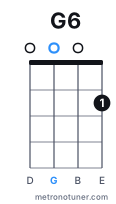
-
Shape 2 · fret 2
no 5th (D)
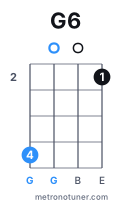
-
Shape 3 · fret 4
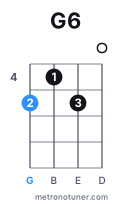
-
Shape 4 · fret 8
no 5th (D)
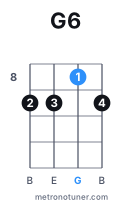
Some shapes leave out: 5th (D). The caption of each one says what is missing. The 5th is the first to go: it barely changes the sound of the chord.
Numbers are fingers: 1 index, 2 middle, 3 ring, 4 pinky. x = do not play the string, o = open string. The coloured dot is the root (G).
G6 inversions on cavaquinho
On the cavaquinho a seventh chord fits whole on the 4 strings, one note on each, and that is how it accompanies in choro. Below are the positions with the root, the 3rd, the 5th and the 7th on the lowest string (in sixth chords the 6th does not go to the bass: that would rename the chord), whenever the position fits the hand.
Root (G) in the bassroot position · G6
Root (G) in the bassroot position · G6
3rd (B) in the bass1st inversion · G6/B
5th (D) in the bass2nd inversion · G6/D
5th (D) in the bass2nd inversion · G6/D
About the sixth chord
A major chord with a sixth: cheerful, "round" and a little retro, without the tension of a seventh. Typical of swing, choro and bossa, and of endings in old-school jazz; in rock'n'roll, alternating the major chord with the 6 is the basis of many riffs.
Notes and intervals of G6
G6 (G sixth) is built from 4 notes. Each one fills a degree of the chord:
- G · 1 · root
- B · 3 · major third
- D · 5 · perfect fifth
- E · 6 · major sixth
Other G chords
Sixth: other roots
Frequently asked questions
How do you play the G6 chord on cavaquinho?
G6 (G sixth) has 4 fingerings on this page, from easiest to hardest. Each diagram shows the fingers, the open strings (o) and the strings you do not play (x), and you can hear every shape.
What notes are in G6?
The notes of G6 are G, B, D, E. The formula is 1 · 3 · 5 · 6: root, major third, perfect fifth, major sixth.
What does G6 mean?
G6 is the chord symbol for G sixth. A major chord with a sixth: cheerful, "round" and a little retro, without the tension of a seventh. Typical of swing, choro and bossa, and of endings in old-school jazz; in rock'n'roll, alternating the major chord with the 6 is the basis of many riffs.
Can I play G6 on other instruments?
Yes. G6 also has a page on guitar, on ukulele, with the fingerings for each instrument.