G#/D# on guitar: G sharp with D sharp in the bass
G#/D# is the G sharp major chord (G♯, B♯, D♯) with its 5th, D♯, as the lowest note: the 2nd inversion of G#. The notes are the same as in G#; only the one at the bottom changes.
- Notes
- G♯B♯D♯
- Bass
- D♯ 5th of the chord
How to play G#/D# on guitar
-
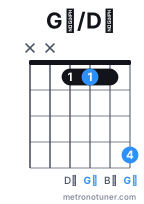
Shape 1 · fret 1 · barre
-
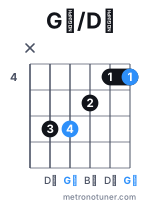
Shape 2 · fret 4 · barre
-
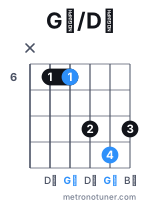
Shape 3 · fret 6 · barre
-
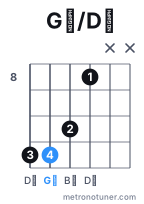
Shape 4 · fret 8
Where G#/D# shows up
The 5th in the bass is unstable and asks to move. The textbook use is the cadence: G#/D# → D#7 → G#, with the bass holding the same note through the first two chords (the "cadential six-four").
Other positions of G#
Frequently asked questions
What does G#/D# mean?
G#/D# reads "G# over D♯": you play G# and the lowest note is D♯. In a chord symbol, whatever comes after the slash is always the bass.
What is the difference between G#/D# and G#?
The notes are the same (G♯, B♯, D♯); only the lowest one changes. With D♯ in the bass, G# is in 2nd inversion, and the bass line can move by step between chords.
How do you play G#/D# on guitar?
The shapes on this page go from easiest to hardest. In all of them D♯ is the lowest note; the low strings that would sound below it are not played (x).