D dominant diminished (half-whole) scale on cavaquinho
The D dominant diminished (half-whole) scale has 8 notes: D E♭ F F♯ G♯ A B C (D, E flat, F, F sharp, G sharp, A, B, and C).
- D 1
- E♭ E flat ♭2
- F ♭3
- F♯ F sharp 3
- G♯ G sharp ♯4
- A 5
- B 6
- C ♭7
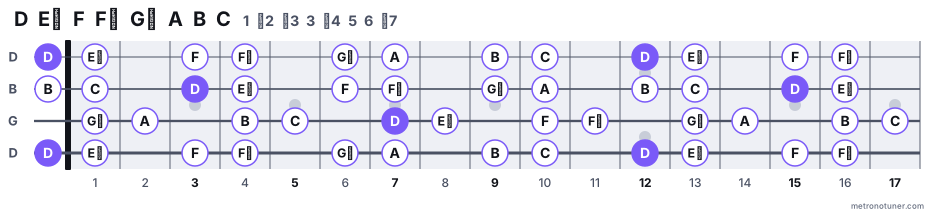
Whole neck: every note of the scale up to fret 17. The root (D) is highlighted.
Positions as text
Position 3 (frets 2 to 7), from the lowest note to the highest:
- string 4: 3 (F), 4 (F♯), 6 (G♯)
- string 3: 2 (A), 4 (B), 5 (C)
- string 2: 3 (D), 4 (E♭), 6 (F)
- string 1: 4 (F♯), 6 (G♯), 7 (A)
Position 4 (frets 4 to 7), from the lowest note to the highest:
- string 4: 4 (F♯), 6 (G♯), 7 (A)
- string 3: 4 (B), 5 (C), 7 (D)
- string 2: 4 (E♭), 6 (F), 7 (F♯)
- string 1: 6 (G♯), 7 (A)
Position 5 (frets 5 to 10), from the lowest note to the highest:
- string 4: 6 (G♯), 7 (A), 9 (B)
- string 3: 5 (C), 7 (D), 8 (E♭)
- string 2: 6 (F), 7 (F♯), 9 (G♯)
- string 1: 7 (A), 9 (B), 10 (C)
Position 6 (frets 7 to 10), from the lowest note to the highest:
- string 4: 7 (A), 9 (B), 10 (C)
- string 3: 7 (D), 8 (E♭), 10 (F)
- string 2: 7 (F♯), 9 (G♯), 10 (A)
- string 1: 9 (B), 10 (C)
Position 7 (frets 8 to 13), from the lowest note to the highest:
- string 4: 9 (B), 10 (C), 12 (D)
- string 3: 8 (E♭), 10 (F), 11 (F♯)
- string 2: 9 (G♯), 10 (A), 12 (B)
- string 1: 10 (C), 12 (D), 13 (E♭)
Position 8 (frets 10 to 13), from the lowest note to the highest:
- string 4: 10 (C), 12 (D), 13 (E♭)
- string 3: 10 (F), 11 (F♯), 13 (G♯)
- string 2: 10 (A), 12 (B), 13 (C)
- string 1: 12 (D), 13 (E♭)
Position 1 (frets 11 to 16), from the lowest note to the highest:
- string 4: 12 (D), 13 (E♭), 15 (F)
- string 3: 11 (F♯), 13 (G♯), 14 (A)
- string 2: 12 (B), 13 (C), 15 (D)
- string 1: 13 (E♭), 15 (F), 16 (F♯)
Position 2 (frets 13 to 16), from the lowest note to the highest:
- string 4: 13 (E♭), 15 (F), 16 (F♯)
- string 3: 13 (G♯), 14 (A), 16 (B)
- string 2: 13 (C), 15 (D), 16 (E♭)
- string 1: 15 (F), 16 (F♯)
Fretboard positions
Each position fits within 5 frets, with 2 to 3 notes per string, and starts on a scale note on the lowest string. Position 1 starts on the root (D).
Use Degrees to see the role of each note (1 is the root) and Listen to hear the selected position going up and down.
Formula
- D
- H
- E♭
- W
- F
- H
- F♯
- W
- G♯
- H
- A
- W
- B
- H
- C
- W
- D
Degrees: 1 · ♭2 · ♭3 · 3 · ♯4 · 5 · 6 · ♭7. Steps: H – W – H – W – H – W – H – W (W = whole step, H = half step).
About the dominant diminished (half-whole) scale
Alternates half and whole steps. Used over dominant chords with an altered 9th, in jazz.
Scales with the same notes
More D scales
- Major
- Natural minor
- Harmonic minor
- Melodic minor
- Major pentatonic
- Minor pentatonic
- Blues
- Major blues
- Dorian
- Phrygian
- Lydian
- Mixolydian
- Locrian
- Nordestina (Brazilian baião)
- Phrygian dominant
- Whole-tone
- Diminished (whole-half)
- Dominant diminished (half-whole)
Dominant diminished (half-whole) in other keys
Frequently asked questions
What are the notes of the D dominant diminished (half-whole) scale?
The notes of the D dominant diminished (half-whole) scale are D, E flat, F, F sharp, G sharp, A, B, and C. The root, degree 1, is D.
What is the formula of the D dominant diminished (half-whole) scale?
In degrees: 1 · ♭2 · ♭3 · 3 · ♯4 · 5 · 6 · ♭7. In steps between the notes: H – W – H – W – H – W – H – W (W = whole step, H = half step).
How do you play the D dominant diminished (half-whole) scale on cavaquinho?
Each position fits within 5 frets, with 2 to 3 notes per string, and starts on a scale note on the lowest string. Position 1 starts on the root (D). There are 8 positions on cavaquinho, each with the full fingering.