A whole-tone scale on piano
The A whole-tone scale on piano has 6 notes: A, B, C sharp, D sharp, E sharp, and G (A, B, C♯, D♯, E♯, G). It uses 2 black keys: C♯, D♯.
- A 1
- B 2
- C♯ C sharp 3
- D♯ D sharp ♯4
- E♯ E sharp ♯5
- G ♭7
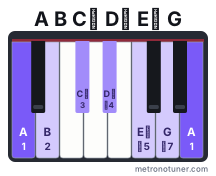
The highlighted keys are the notes of the scale, with the name and the degree; the tonic (A) has the strongest color. Tap a key to hear the note; "Play" goes up and down. The small dot marks middle C (C4).
Fingering for the A whole-tone scale
This scale has no single fingering in piano method books. A rule that works: never put the thumb on a black key, and pass the thumb right after a black key. Fingers: 1 = thumb, 2 = index, 3 = middle, 4 = ring, 5 = little finger.
Formula
- A
- W
- B
- W
- C♯
- W
- D♯
- W
- E♯
- W
- G
- W
- A
Degrees: 1 · 2 · 3 · ♯4 · ♯5 · ♭7. Steps: W – W – W – W – W – W (W = whole step, H = half step).
About the whole-tone scale
Six notes a whole step apart. Mysterious and dreamlike; fits augmented chords.
Scales with the same notes
More A scales
- Major
- Natural minor
- Harmonic minor
- Melodic minor
- Major pentatonic
- Minor pentatonic
- Blues
- Major blues
- Dorian
- Phrygian
- Lydian
- Mixolydian
- Locrian
- Nordestina (Brazilian baião)
- Phrygian dominant
- Whole-tone
- Diminished (whole-half)
- Dominant diminished (half-whole)
Whole-tone in other keys
Frequently asked questions
What are the notes of the A whole-tone scale?
The notes of the A whole-tone scale are A, B, C sharp, D sharp, E sharp, and G. It uses 2 black keys: C♯, D♯.
What is the formula of the A whole-tone scale?
In degrees: 1 · 2 · 3 · ♯4 · ♯5 · ♭7. In steps between notes: W – W – W – W – W – W (W = whole step, H = half step).